
Thought Leadership Is a Fuzzy Word. But It Matters Anyway.

It took years to build the discipline of writing regularly. It took surprisingly little time to break that habit once the routines and structures that supported it disappeared. That, too, has become part of my own learning around thought leadership.

Starting is difficult.

But restarting may be even harder.

A consultant I once worked with used to describe concepts that mean different things to different people as “fuzzy words.”  Thought leadership suffers from exactly this kind of fuzziness.  It is a term tossed around frequently, but rarely well understood.

In recent weeks, across my coaching and consulting work, I have found myself returning to the same conversation again and again.  Leaders understand instinctively that thought leadership matters, but often struggle to define what it actually means, to make space for it amid competing demands, or to develop the habits necessary to do it consistently.

As many schools have already begun, or will soon begin, their summers, I am reminded that summer offers leaders something increasingly rare during the school year: time to reflect and time to plan.  So perhaps this is the right moment to talk about thought leadership.  What is it?  How can leaders use it in service of their schools and organizations?  And why does cultivating thought leadership benefit not only leaders themselves and those they directly serve, but the broader field as well?

Part of the confusion, I think, stems from the fact that people hear the phrase “thought leadership” and immediately think self-promotion. Branding.  Visibility.  Social media.  The rise of LinkedIn has not exactly helped matters.

But real thought leadership is something quite different.

At its best, thought leadership is contribution.  It is the discipline of making your ideas, questions, observations, lessons, and experiences visible so that others can learn from them.  It is a way of strengthening not only the institution you serve, but the broader community of practice to which you belong.

It is also worth acknowledging something that sometimes goes unsaid. Thought leadership can have real professional and organizational benefits. Leaders who contribute thoughtful ideas publicly often strengthen their own professional reputation.  By extension, they strengthen the reputation of the schools and organizations they serve.  Visibility matters, and credibility built through authentic contribution can become a powerful form of institutional marketing.

But I think it is important to understand this correctly.

When thought leadership is approached primarily as branding, audiences sense it immediately.  The work becomes performative rather than generative.  The strongest thought leadership begins not with the desire to be seen, but with the desire to contribute.  Ironically, when leaders focus first on contribution, the benefits to reputation and organizational visibility often follow naturally.

There is another dimension of thought leadership that I think school leaders sometimes overlook.

Thought leadership is not only outward-facing.  It is not simply about contributing to the broader field or building one’s professional voice publicly.  At its best, it is also an essential tool of leadership itself.

I have long believed that one of the most important responsibilities of institutional leadership is serving as what I often call the “storyteller-in-chief.”

Schools are constantly changing.  Strategic priorities shift.  Communities experience uncertainty.  New initiatives require buy-in.  Difficult decisions must be explained.  Culture does not sustain itself automatically. In moments like these, leaders cannot simply make decisions.  They must help people understand the story behind those decisions.

Thought leadership is one of the primary ways leaders do this work.

A thoughtful email to families.  A reflection shared with faculty.  A blog post explaining the “why” behind a new initiative.  A public articulation of values during moments of uncertainty.  These are not marketing exercises. They are leadership acts.

In many ways, thought leadership becomes one of the most powerful tools leaders have for leading change itself.

People rarely resist change because they object to strategy alone.  More often, they resist because they have not yet been invited into the story of why change is necessary.

Good leaders manage institutions.

Great leaders help communities make meaning.

I know some of these challenges firsthand.

For years, when I served as a Head of School or as Executive Director of the Schechter Day School Network, I maintained a fairly disciplined weekly blogging practice.  Part of what made that possible was clarity.  I understood my audiences.  There were parents, faculty, lay leaders, colleagues across the network, and the broader Jewish educational community.  I knew who I was speaking to, even when the message resonated differently with each group.

My professional life looks different now.  As a consultant and coach working across schools and organizations, I sometimes find myself less certain about audience.  Am I writing for clients?  For the field?  For leaders I mentor?  For colleagues?  The answer is often some combination of all of them, which paradoxically can make writing feel harder rather than easier.

And perhaps the more humbling lesson has been this: habits are fragile.

It took years to build the discipline of writing regularly.  It took surprisingly little time to break that habit once the routines and structures that supported it disappeared.  That, too, has become part of my own learning around thought leadership.

Starting is difficult.

But restarting may be even harder.

I think about this often in my mentoring work with participants in programs like DSLTI, where thought leadership has increasingly become part of the leadership conversation.  We ask educational leaders not simply to run organizations, but to contribute to the thinking of the field itself.

That matters.

The strongest fields are built when thoughtful practitioners share what they are learning in real time.  When leaders make visible not only their successes, but their questions.  When schools solving difficult problems contribute those lessons so that others do not need to reinvent the wheel alone.

And the channels for doing this have never been more accessible.

Blogs.  LinkedIn.  Podcasts.  Journal articles.  Conference presentations. Newsletters.  Short-form social writing.  The barrier to entry has largely disappeared.

What remains difficult, as always, is beginning.

Or beginning again.

So perhaps that is my encouragement as summer begins.

Do not think of thought leadership as another professional obligation or another performative exercise in personal branding.

Think of it as contribution.

Every school leader is learning lessons worth sharing.  Every organization is solving problems others will eventually face.  Every thoughtful practitioner carries insights that can strengthen the larger field if they are willing to make them visible.

The field does not need more polished experts speaking with certainty.

It needs more thoughtful practitioners willing to share what they are learning in real time.

And if you have been meaning to begin, summer may be the perfect time.

And if, like me, you are trying to begin again, perhaps that is enough reason to start.

And perhaps this is one of the conversations I find myself having more often in my coaching work.

Not simply helping leaders run stronger schools, but helping leaders find their voice. Helping thoughtful practitioners recognize that their ideas, their questions, and their lived experiences have value beyond the walls of their own institutions.

In that sense, perhaps the work is not only developing thought leadership.

It is learning how to become better thought partners for one another.

The Art of Coaching

When I was a Head of School, I often told my administrative team: we should treat our teachers at least as well as we treat our students.

We know students have different learning profiles, personalities, anxieties, motivations, strengths, and needs. We differentiate instruction. We scaffold growth. We personalize support.

And yet, when it comes to adults, schools often abandon that wisdom.

When I was a Head of School, I often told my administrative team: we should treat our teachers at least as well as we treat our students.

What I meant was simple. We know students have different learning profiles, personalities, anxieties, motivations, strengths, and needs. We differentiate instruction. We scaffold growth. We personalize support. We understand instinctively that what works for one child may not work for another.

And yet, when it comes to adults, schools often abandon that wisdom.

Teachers are handed identical professional development regardless of experience or readiness. Leadership feedback is delivered as though every adult processes challenge the same way. Boards sometimes expect Heads of School to respond identically to pressure, ambiguity, or change. We speak often about differentiation for children while treating adult growth as though it were standardized.

Becoming a coach has only deepened my conviction that this is backwards.

Over the past year, through my work with Scott Goldberg Consulting, my mentoring work in DSLTI, and countless conversations with school leaders, I have become increasingly convinced that the real art of coaching lies not in mastering a single framework, but in learning how to thoughtfully adapt frameworks to actual human beings in actual contexts.

Our “Iceberg Is [Never] Melting”! #Kotter #IYKYK

Leadership literature is full of models, and many of them are enormously valuable. Adaptive Leadership. Kotter. Lencioni. Cognitive coaching. Change management theory. Strategic planning frameworks. Each offers language, structure, and insight. I use them regularly.

But none of them, on their own, are the work.

The work is interpretation.

A skilled coach is constantly making judgments. Does this leader need more challenge right now, or more reassurance? More structure, or more permission? Is the resistance in front of them technical, emotional, relational, or existential? Is the issue actually strategy, or is it exhaustion? Is the board asking the wrong question? Is the leader carrying a story about themselves that no longer serves them? Is the timing wrong? Is the system itself producing the dysfunction?

Two school leaders can face nearly identical problems and require completely different coaching approaches. One may need accountability and directness. Another may first need trust and confidence rebuilt. One leadership team may benefit from conflict surfacing quickly. Another may need slower pacing and stronger relational foundations before difficult truths can safely emerge.

This is why coaching, at its best, feels less like engineering and more like craftsmanship.

Or perhaps more precisely: artisan work.

An artisan works with materials that are living, variable, and contextual. The work requires technique, yes, but also patience, intuition, responsiveness, and deep attentiveness to what is actually in front of you. The same tools are not applied identically every time. The craft lies in the adaptation.

I think this is part of why my work continues to resonate so deeply for me. One of the quiet gifts of mentoring leaders over time is discovering how differently leadership develops in different people. Some leaders need encouragement to become more decisive. Others need encouragement to slow down and listen. Some need help finding their voice. Others need help creating space for other voices. Some leaders are trying to build systems. Others are trying to rebuild trust. Some are navigating institutions that are healthy but anxious. Others are navigating institutions that are fragile but hopeful.

There is no single roadmap for any of them.

The irony, of course, is that educators already understand this deeply when it comes to children.

No thoughtful teacher would say: “I taught the lesson perfectly, so why didn’t every student learn it the same way?”

Teachers understand that learning is relational. Contextual. Emotional. Developmental. Growth depends not only on content, but on timing, trust, readiness, environment, and support.

Adult growth works the same way.

The best leadership coaching I have experienced, received, or observed has never felt formulaic. It has felt attentive. A good coach listens for patterns, but also for absences. For fears that are disguised as strategy conversations. For conflict avoidance disguised as consensus. For exhaustion disguised as resistance. For institutional stories that quietly shape behavior long after anyone remembers where those stories began.

Good coaching requires frameworks. Great coaching requires discernment.

And perhaps that is the deeper lesson schools still have to teach us. Human development does not end in childhood. Adults continue to grow through many of the same conditions that help children thrive: trust, challenge, reflection, clarity, belonging, accountability, and care.

The best coaches understand this.

Not because they have mastered a program.

But because they have learned to approach leadership as human work.

What #Amplification Looks Like

One of our #NorthStars is that #WeLearnBetterTogether.  It is always important to remember that these aren’t just hashtags or slogans and they aren’t just for students.  They are there to guide our path and inspire our decisions.  Therefore, I thought it might be worthwhile to look a little more closely at how just part of this North Star actually actually plays out.

This is just about the time of year where we finish our first round of conversations with teachers about their progress, performance and professional growth.  With the unveiling of a new OJCS Learning Target (how we believe teaching and learning should look) last year, we have identified “Amplification” as a key pillar.  At the highest level, when we talk about a teacher’s “professional amplification”, we are looking for things like:

  • Teacher participates in school-based and online learning communities to access and extend continuous, ongoing professional learning for self, and effectively shares with colleagues knowledge about current thinking, methods and best practices in education
  • Teacher works in collaboration with others to design robust learning tasks and obtain feedback about instructional planning from colleagues and mentors, or acts as mentor or peer coach.
  • Teacher takes the initiative to inform self about current research literature and incorporates it into teaching and learning practices.
  • Teacher shares thoughts about current research openly on digital platforms.  Parents, experts and members of the larger community are invited to respond to it.
  • Teacher actively and regularly connects their own work to educators from around the world via a variety of platforms.

I thought it would be fun to see how the faculty of @The_OJCS learns with and from each other and the world.  As I have done once before, since Twitter is the platform of choice for teachers who amplify, I thought I would share a little Wakelet of recent activity:

Our students are the beneficiaries of all this amazing crowdsourced wisdom and I am so proud to work in a school where so many teachers (and it is so many more teachers – and part of Mrs. Thompson’s role as Teaching & Learning Coordinator is to do this work, which is why you see her so frequently – and comes in so many more ways than just a one-week glance at Twitter) learn from each other and the wider world!

You know who else amplifies at OJCS?  Our students!  Through their student blogfolios (Grades 4-7 and growing!) and through Classroom Twitter accounts.  But that’s for another blog post…

The OJCS Announces $165,000 Professional Growth Gift

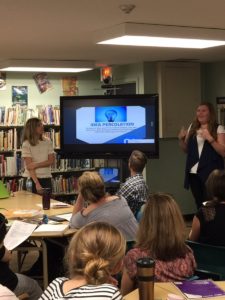
In our first faculty meeting this week, members of our NoTosh DesignTeam share our “Prototype Process” with the rest of the faculty.

This is not a flashback to a flashback! We are not reminding you of the $72,000 Innovation Grant we received from the Congregation Beth Shalom of Ottawa (CBSO) Legacy Fund to help fund some of the physical spaces we’ll need to continue to bring our innovative vision to life.  We are also not reminding you of the $50,000 Innovation Grant we received around this time last year from an anonymous family which helped fund the transformational work we recently finished with NoTosh (which lives on this year in the many powerful prototypes presently being prepared for pitches to bring teaching and learning at OJCS into greater alignment with our “North Stars”), the opportunity to double our iPads available in the school, the exciting shift towards providing teachers with Chromebooks so they can collaborate more effectively and model what learning looks like, and beginning just this week, our work with this year’s consultant, who happens to be my friend and former colleague Silvia Tolisano, whose new book the cohort of teachers working with Silvia have begun to read.

Silvia Tolisano beginning her work with a new cohort of teachers – and the full faculty – as we examine what learning is, where to find it, how to document it and learning to learn.

[I will have a lot more to discuss about Silvia’s work next week as it ties into the launch of our OJCS Blogosphere…]

No, this post is yet another example of how the work we are doing at the Ottawa Jewish Community School is not only transforming teaching and learning in our classrooms, but transforming the role of the school in our larger Jewish and educational communities.  The ripple effect of this work is not only inspiring current and prospective parents, but current and prospective donors.  We noticed this back in June when we observed:

Success begets success.  Numbers beget numbers.  A school in motion will stay in motion.  The narrative of decline is behind us; the narrative of rebirth, revitalization and rejuvenation has begun.  You can measure it objectively through numbers – attrition down, enrollment up, survey data trends, fundraising dollars, etc.  You can also measure it subjectively – feelings in the walls, word on the street, buzz in the community, etc.  You can measure it however you like.  The outcome is the same. The OJCS is laying the ground to become the innovative leader in education in our community.

And wow has that been true!

With over 170 students and our largest Kindergarten class (28) in years, and all the other optimistic indicators I wrote about at the very beginning of the year, we are off and running.  So what is going to keep us running to meet and surpass all our ambitious goals?

A school is only as great as its teachers, and its teachers can only excel if they are given opportunities to engage in meaningful, sustained, personalized, professional growth.  Twenty years of educational research shows that an investment in teachers is a (if not the) key lever in determining excellence and is among the few variables a school can completely control.

We know it is true

Part of our recent success can be attributed to how we have raised the bar of expectations for our teachers while providing them with coaching, resources and support they need to reach new heights.  In the course of a single year, even our veteran teachers have found renewed commitment to lifelong learning and our new teachers are brimming with ideas. What unites them in bringing our mission to life is a comprehensive commitment to professional learning.

Customized professional development

At OJCS, we believe what is good for our students is also good for our teachers.  In the same way we recognize that students are individuals with their own learning styles and motivations, we acknowledge that our teachers can also benefit from a similar action plan.  There are no “one-size-fit-all” approaches for meaningful growth. That is why, though still in its nascent stages, our goal is that each teacher has a well-developed individual Professional Growth Plan, developed in partnership with the administration and consisting of clear deliverables for mutual success.  These plans then allow the administration to understand common needs and determine what outside resources should be made available to our faculty.

Professional growth at OJCS is achieved through a blended and customized approach with various elements, from participation in conferences, to purchasing individual books and learning tools.

Importance of expert consultants

We have already discussed the impact of NoTosh and the beginnings of the work of Silvia.  In addition to those large initiatives, we have also begun smaller initiatives :

  • Teachers visit other schools
  • Teachers are assisted in achieving new degrees
  • New books are being purchased for our faculty library
  • Webinar access is being purchased for teacher training

Building a brighter future

Thanks to the generosity of one amazing family and the ongoing participation of our partners at the Jewish Federation of Ottawa, this new gift of $165,000 over the next five years, the work will continue with customized development (e.g. webinars, conferences, site visits, etc.), and the best practices learned from the consultants will be implemented.  These are likely to include curriculum mapping and enhanced mentoring/coaching. Examples include: providing opportunities for Jewish and French Teachers to further develop their skills as teachers of second (and third) languages; and connecting teachers of Jewish Text to coaches through Prizmah.

For a school of our current and future size, an enhanced and sustained focus on professional development is required as a primary lever for future success.  This extraordinary gift will ensure that the OJCS Faculty has access to the latest research, current trends, coaching, conferences and materials necessary to provide the Jewish children of Ottawa with an innovative, world-class education and help secure the future of our Jewish community.

And, as we say…that’s #TheOJCSDifference